Logo Hexental

Austrian Army Kennels

To homepage

To homepage menu

The history of the Austrian Rottweilers

The Austrian Army Kennels "von der Karl Adolf Ranch" history

The Czechoslovakian Army Kennels history

The history of the War dogs


The history of the Austrian Rottweilers,

by Guy Verschatse.

1946

AUSTRIA

Because my fascination about the Austrian dogs I've done research about the source of these fine dogs.

It brings us back to 1922 : the first Rottweilers were born in Austria !

No names or any information about these dogs are found back because at that time our breed was no big success: only about 350 dogs have been registered in the OEKV (Austrian Kennel club) from 1922 till 1940.
In the second World-War the few dogs who were living in Austria where used as army-dogs and never returned, on plus because of a fire in the archives of the OEKV all pedigrees where lost also.

It was in 1948 the real Rottweiler-story began with a Mrs. Antonia Billy. It was she who was the founder of the post-war Austrian bloodlines with her kennel "v. Waldbachstrupp". Mrs. Billy imported the female "Barbel v. Bulach, ZB 29248" and the male "Droll zum Bruckenwirt, ZB 29262" both from Germany. 29.08.1950 was a historical moment for Austria: the "A" litter from the Waldbachstrupp-kennels was born. However out of the "H" litter important producing-bitches were born: "Heda & Hera v. Waldlbachstrupp" are the roots of the modern OERK-lines. They were out of "Racker v. Kohlwald x Fuse v. Waldlbachstrupp". Heda was raised with Mrs. Assanger and give birth the first time in 1958 in the famous "v. Sandhubeln-Kennels".  

This kennel is the base of lot's of great Austrian dogs. Mrs. Assanger exported several dogs to Czechoslovakia who had a big influence over there. Her relations in that country were also part of the fact that she imported two bitches from Czech-breeding: "Comtess z Michelova Dvora" and "Ani Kotesovka" who have given later on a important influence in the OERK-bloodlines.

Begin the 50's there was also a kennel called "vd Welser Traunau" who bred the bitch "Annamirl vd Welser Traunau" both out of ADRK-dogs, this bitch was the foundation bitch of Mr. Alfred Gnesetti from "vd Mansarde". Mr. Gnesetti bred several dogs who were exported to Germany and bred into the German genepool. "Nik vd Mansarde" was also the sire of the "M" litter "v Sandhuebeln".

Remarkable is the fact that about 80% of the OERK breeders were-and still are situated around Vienna. The Vienna Police started in 1963 his own kennel: "v. Franz-Josefs Land" with "Onda v. Sandhuebeln" as foundation bitch (a unique fact is that Austria is one of the only countries in the world who's Police - and Army Forces breed there own dogs).

In 1966 was the first litter out of another very famous kennel "v. Bruckertor" born. The second litter has produced a famous international stud "Bero v. Bruckertor".

A little later (1968) the Austrian Army started there a big breeding-program in the "v. d. Karl-Adolf Ranch-kennels". "Milo v. Kursaal" (ADRK-import) was a very important producer for this kennel and the rest of Austria.

In 1970 the kennel: "v. d. vierten Donaubrucke" produced "Attila" who was the grandfather of world's most respected producer: "Dingo v. Schwaiger Wappen".

In 1972 was the year of foundation of another important kennel: "v.d. Rottweilerheide" who produced "Zeno v.d. Rottweilerheide". The Breeder and owner of Zeno was the OERK-Headbreedwarden of that time: Mr. Peter Wolf. It is evident that Zeno was responsible for many offspring.

The 70's were completely dominated by following OERK-males:

Baldur von der Karl-Adolf Ranch

Enzo von der Karl-Adolf Ranch

Attila vd vierten Donaubrucke

Bero v. Bruckertor

Rustan v. Festenstein

Zeno v.d. Rottweilerheide

Because the OERK-bloodlines were strongly line-bred they had to bring fresh blood into there dogs and from the 80's on more and more ADRK-studs were used.

This influence became so big that in the +/- 250 litters, who were born between 1980-1990, 50% were German Sires. In the 90'S this increased till 70-80%.

Now almost nothing has left anymore of the great-old-OERK-bloodlines what is a real shame...

PS. At the "v. Schloss Hexental-kennels" we strive to bring as much as possible of this old Austrian-blood back into our dogs.

Copyright by Guy Verschatse

Belgium


Top

The Austrian Army Kennels history, by Guy Verschatse.

logo militärghundestaffel

 Emir von Kaisersteinbruch, MIL.DH (brother to Eliott)


AUSTRIAN ARMY

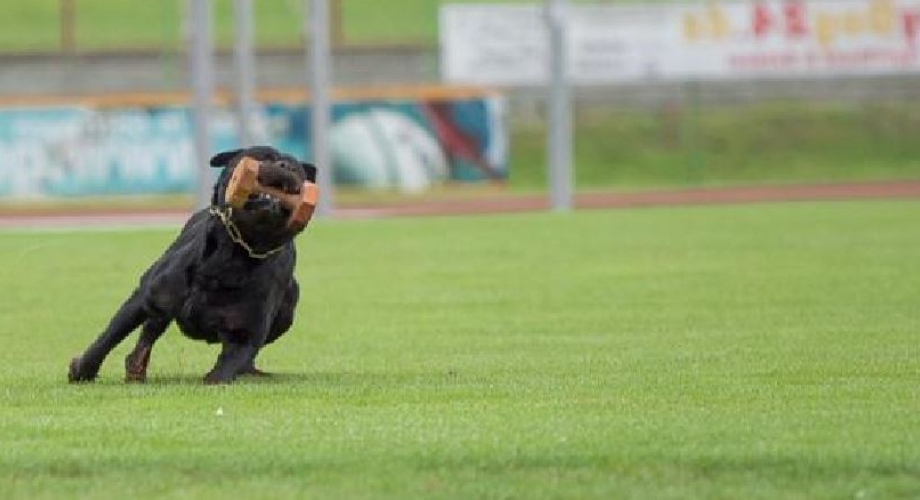
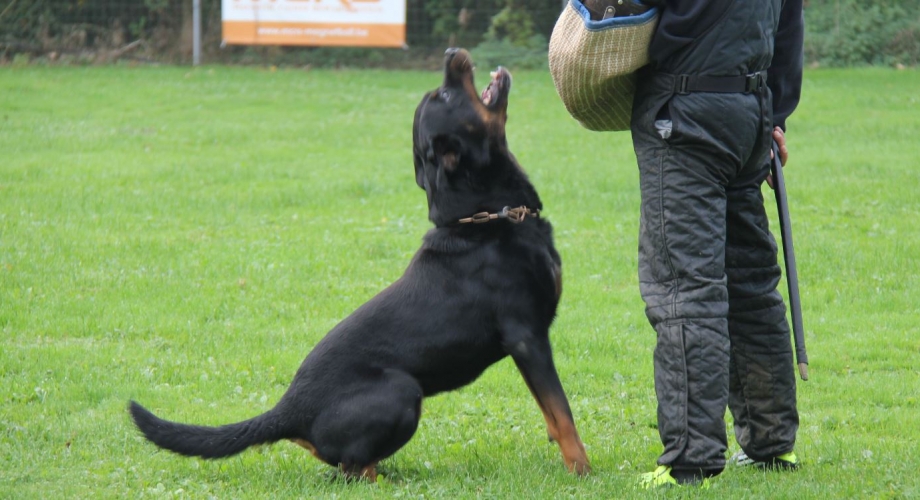
In my search for the ultimate working Rottweiler I've found the "von der Karl-Adolf Ranch" kennels in Austria. Austria is a unique country in the dog world: they breed their own service-dogs, and what's more +/- 85% of all duty-dogs are Rottweilers! The Austrian Forces believe that the Rottweiler is far the best service-breed worldwide because of his calm and self assured nature, his phenomenal courage and impressive look. This breed does not bark easy and therefore not "betray" the presence of his team-member till the very last moment. 

The foundation of the "MilHuSta" (Military Dog School) was made in 1958 with the help of the Herr Friedrich Hofmockel from the ADRK, but established in 1964 near Vienna (Bruckneudorf) in South-East Austria. S-E Austria is the boarder of the former "Eastern-Block" and by this a strategically point for economical refugees and criminals. The Vienna area was several times a critical point in political history, you can call it the place where "East" meets "West". The Austrian Army started with four German Shepherds (GSD's) who were a present of the Austrian Border Patrol. Soon the Milhusta started to know the benefits of using Rottweilers as overall-duty dogs with the OERK-bitch "Assi v.d. Mais".

Herr Adolf Ringer (born in 1938 in Vienna, reputed Judge and Körmeister of Rottweilers) became Breedwarden and Commander of the Milhusta-kennels. He and Brigadier Vet.Dr. Kurt Karl Albrecht started their breeding-program with two OERK- littersisters "Burga & Birgit vd Mais" (Caspar v.d. Löwenau x Sissi v. Sandhübeln) and one ADRK-import male "Milo v. Kursaal" (Blitz v Schloss Westerwinkel x Wilma v Kursaal). All the puppies get the kennel-name: "v.d. Karl-Adolf Ranch" ("Karl" Albrecht & "Adolf" Ringer). Out of the second litter they bred already a top-producer: "Baldur v.d. Karl-Adolf Ranch" who is one of the forefathers of the great "Dingo v. Schwaiger Wappen", "Bea v.d. Hembachbrücke" and "Karo v. Schwaiger Wappen". These Austrian Army dogs can be considered as the roots of the modern Austrian- and some of the modern German dogs. Mr. Ringer was responsible for many events and retired around 1987. Behind the scene the German Mr Hofmockel (trainer of the famous Arko v Georgshof, co-owner of the "vd Hahnenbalz" kennel and DM in 1958 and 1964) was a very important source for the selection and training of the Milhusta dogs. He stayed in very close contact till the retirement of Mr Breuer.

The "vd Karl-Adolf Ranch" kennel is mostly build up over following dogs:

Milo v Kursaal (ADRK-import)

Baldur von der Karl-Adolf Ranch

Arko v Georgshof (ADRK)

Enzo & Esther von der Karl-Adolf Ranch

Lesko & Lasso von der Karl-Adolf Ranch

Bero v. Bruckertor

Murl von der Karl-Adolf Ranch * 

Axel v Werthfeld

Zirra & Zenzi von der Karl-Adolf Ranch

Arko v Trettachtal

Marco vd Burg Rottweil

Moritz v Karner *

Filou vd Bleichstrasse (ADRK-import)


Murl von der Karl Adolf Ranch, MIL.DH                                                Moritz v Karner, MIL.DH (son from Uno vd K-A Ranch)

From than on the leading figure of the Milhusta became Herr Johann (Hans) Breuer who was a true enthusiast of our breed. He changed the image of the previous Breedwarden into a more sociable type of dog. Mr. Breuer was a known guest in Germany at ADRK Koerungs & Klubsieger-shows, always looking around for the suitable stud for "his" kennel. Hans did this splendid job till he retired around 2001.

The leading lady from than on carried the name of Mrs. Angelika Schandl. She's taken over the tasks of Breedwarden and head-trainer which is a very heavy load for a newcomer...

In 1991 the Milhusta changed their kennel-name to "von Kaisersteinbruch". From the beginning on (1964) all dogs were bred in the military base in Kaisersteinbruch, however in 1999 a brand new breeding and training facility was ready. This complex can be considered as one of the most modern and professional in the world ! Till now (2003) the Milhusta bred about 1240 Rottweilers, the most recent years they've bred about 5 litters each year. They started to breed the 12 till 13th generation at this time. Out of their litters about 70-80 % is useful as Diensthund. Only some of the very best of these service-dogs are used to their breeding-stock. 

The Militaer-Hundestaffel exits out of following structure:

1. Commando (Board and Organization)

2. Nutrition group (they cook every day fresh food, except in the weekend)

3. Training group (school for: dogs, military dog-handlers and judging of both)

4. Kennel group (boarding en breeding)

All dogs bred and kept by the Austrian Army are in perfect health and condition, which is tested by all kind of severe medical examinations. Maybe interesting to know is the fact that these dogs drink camilla-thee every day (specially after duty or training) because of the herbal benefits. The servicedog-prospects are raised and pre-trained till 20 months at the Milhusta-base and are than trained with their future handler for 3 months in a row. After this period they are tested and the successful combinations are used as service units. The dog is living from than on at his trainers residence till he retires at 8-9 years. Than he becomes property of his trainer, no retired dogs are put down or are eliminated. The official service-dogs are used in the most critical radar-sites, ammunition-stocks and all kind of boarder-conflicts. During the years under communist regime of Hungary and Czechoslovakia the Austrian Army dogs would apprehend several people on a daily basis. While 9 out of 10 people would give up when confronted, these Rottweilers were regularly called upon to defend their handlers from those intent on crossing the boarder or Military property at what ever cost. The "v Kaisersteinbruch" dogs continue to be called upon to respond daily in risky and threatening situations. 

The MIL.DH exam:

This exam is always done on a neutral field (in the wood and-or in the open). It exists out of a obedience-part and a bitework-part, no tracking. The obedience discipline is a mix of the sociability-part of the BH and the obedience-part of a SCHH3 (without retrieve and gunshots) + positions "sit, down and up" by hand-signs, climbing over difficult objects such as ladders and "sneak" over the ground. The bitework-part is done on a "full biting civil-costume" and exists out of 4 exercises, all the gunshots are given during this bitework. First is the revier-exercise (seach & hold) of the "bad guy", than a menace on the owner and final the 100 meter courage test (long distance attack) + disarming and transport.


 We at "vom Schloss Hexental-kennels" strive to linebreed as much as possible on these exceptional "Karl-Adolf / Kaisersteinbruch" dogs. We are proud to call our self "specialists on this substance". Our previous stud-dog "Igor von Mutmannsdorf" carried the bloodlines of the foundation dogs of the famous "Karl-Adolf-Ranch-kennels"! 

Now (2004) the Milhusta owns 2 males and 1 female from our kennel, Casnar, Unohex and Dara v Schloss Hexental.

We at Hexental own 2 stud dogs and 1 broad bitch from direct "Karl-Adolf / Kaisersteinbruch" blood. See "BODO", "CONAN" and "DORLE".


More info on this Austrian subject you can find in our book "30 years of European Rottweiler breeding 1970-2000" which you can purchase by clicking on our "Index-page". 

You can also purchase the one and only VHS video of the Milhusta "Rottweiler im Dienste der Menschen, Hans Breuer" from my friend and former ADRK Headtrainingswarden: Mr Martin Hilgemann, Neusser Strasse 741, D-50737 Köln.

Copyright by Guy Verschatse

Belgium


Stephan von Kaisersteinbruch, MIL.DH, grandsire of Bodo v Schloss Hexental


Eliott von Kaisersteinbruch, MIL.DH, sire of Conan v Schloss Hexental


Brutus von Kaisersteinbruch, MIL.DH, sire of Dörle v Schloss Hexental


Quaxi von Kaisersteinbruch, MIL.DH


And the younger generations:  Akim von Kaisersteinbruch, MIL.DH  &  Arno von Kaisersteinbruch


Top

The Czech Army Kennels history, by Guy Verschatse.

CZECHOSLOVAKIAN ARMY

In my worldwide search for the ultimate working Rottweiler I've also found the "z Pohranicni Straze" ("from Border Patrol") kennels in former Czechoslovakia. Czechoslovakia was also one of the unique countries in the dog world where they bred their own service-dogs, Rottweilers and mostly German Shepherds.

Prior to the 1989 revolution in the Czech Republic, which led to the fall of the communist government, the breeding of service-dogs was predominately that of the "real world" working dogs. What's unique about this fact is that all breeding has revolved around one kennel, owned by the Czech Army Border Patrol.

This kennel "z Pohranicni Straze" was founded in the year 1955 for the only purpose of production and training of the dogs that would be used for the protection of the Czechoslovakian Communist Republic borders. The most of the dogs used for breeding were acquired from the territory of former East-Germany (DDR), from Austria and also from Czechoslovakia himself. Only the ones that excelled in their character qualities were used.

Mr. Antonin Tomanek was the Breedwarden of the Czech Army kennel and the GSD-breeding program, who was established in 1956. However from 1966 a Rottweiler-breeding program was set up. This breeding program has been since the foundation focused mainly on strengthening the strong construction, dark pigmentation, solid nerves and working drives. The Rottweilers were bred till 1977 where they suddenly stopped for a unknown reason. 

Some of the foundation dogs were "Fargo z Starkova Dvora" (Rustan v Sandhuebeln x Betty v Birkenhain), "Britta Veznicke Vrchy" (Blanko v Ohrental x Cedra Kralicky Sneznik), "Flotty z Michelova Dvora" (Arol Kralicky Sneznik x Vera v Sandhuebeln) and the ADRK-stud "Bari v Erlenhof". These dogs are the roots of the modern Czech Rottweilers. As you can see the Czech genepool is completely isolated and different as any other former "Eastern-Block" country. Mr. Tomanek retired around 1981 and was followed up by Mr. Jiri Novotny who's still the leading figure at the moment (2004).

During the years under the communist regime, the Czechoslovakian boarder patrol and their dogs have arrested or stopped many people on a daily basis. While most of them would give up when confronted, these dogs were regularly called upon to defend their handlers from those intent on crossing the boarder at what ever cost (or was it to keep out the "bad capitalists" ?). Today the Czech Boarder Police share boarder-stations with their German counter parts who maintain a tight control over economical refugees from former "Eastern-Block" entering Germany. Those who are not given visa's to legally enter Germany attempt to cross this same Czech boarder. While many are crossing to seek a better life in Western Europe and usually don't resist arrest, an increasing number are connected with organized crime and are pose a considerable threat. The "z Pohranicni Straze" dogs continue to perform daily in these real life situations, however after the "cold war" the number of incidents dropped drastically. The training courses to prepare them are likewise demanding as are the requirements for breeding. While the kennel-name still remains "z Pohranicni Straze", it is now under the Czech Boarder Police.

The "z Poharicni Straze" kennel is mostly build up over following dogs:

Bruno z Michelova Dvora

Fargo z Starkova Dvora *    

Bari v Erlenhof * (ADRK-import)                 

Axel & Arno z Pohranicni Straze *

Cid & Rony z Pohranicni Straze

Certa z Pohranicni Straze

Rek z Pohranicni Straze

Aramis z Ol-Ze CS *


Fargo z Starkova Dvora              Bari v Erlenhof                        Axel z Pohranicni Straze              Aramis z Ol-Ze CS

There are 3 breeding facilities with a total of 80 GSD breeding females that make up the "z Pohranicni Straze" kennel. There are about 30 GSD stud dogs, all of which are on active duty with their handlers. The breeding-facilities are located within the Czech Boarder Police compounds in Domazlice, Libejovice and Prackovice. These compounds have high security status with access to them strictly forbidden to anyone, including Czechian's who do not work at the specific facility. The stud dogs, females and puppies are taken care after military-service conscripts. The dogs are trained at the kennels for about 12 months and afterwards relocated to Border Patrol training-facilities in their quarters. 

It is a real shame that this interesting Rottweiler-project was cancelled after 11 years and about  4 generations of selection...

Copyright by Guy Verschatse

Belgium


Top

Some Pictures:

Austrian army


Hans Breuer, total left.


Angelika Schandl, in the middle.


Top

Some ADRK-dogs with OERK bloodlines

1 Uwe v. Kursaal Bodo v.d. Mais (OERK) Caspar v.d. Löwenau
Sissi v. Sandhübeln (OERK)
Burga v. Mühlertal ADRK
ADRK
2 Dingo v. Schwaiger Wappen Ives Eulenspiegel ADRK
ADRK
Anja v. Schwaiger Wappen Atilla v.d. Vierten Donaubrücke (OERK)
Anka v. Lohauserholz
3 Bea v.d. Hembachbrücke Ives Eulenspiegel ADRK
ADRK
Anja v. Schwaiger Wappen Atilla v.d. Vierten Donaubrücke (OERK)
Anka v. Lohauserholz
4 Bandit v. Grüntenblick Ferres v. Hause Winter Bero v. Brückertor (OERK)
Cora v. Hause Winter
Aris v. Duracher Tobel ADRK
ADRK
5 Duna v. Grüntenblick Ferres v. Hause Winter Bero v. Brückertor (OERK)
Cora v. Hause Winter
Bea v.d. Hembachbrücke ADRK
ADRK
6 Karo v. Schwaiger Wappen Cork v.d. Hahnenbalz Enzo von der Karl-Adolf-Ranch (OERK)
Jessica von der Karl-Adolf-Ranch (OERK)
Froni v. Schwaiger Wappen ADRK
ADRK
7 Merkur v. Bayernland Bandit v. Grüntenblick ADRK
ADRK
Sally v.d. Hagenbach Klamm (OERK) Demon v. Schloss Fischlham (OERK)
Espe v. Karner (OERK)
8 Cloë v. Burgthann Quinn von der Karl-Adolf-Ranch (OERK) Arko v. Trettachtal (OERK)
Assi von der Karl-Adolf-Ranch (OERK)
Flocke v.d. Silberdistel ADRK
ADRK
9 Bora v. Pfaffengraben Aron v.d. Elbemuhle (OERK) Jumbo v. Küpferdach
Anka v. Schloss Viehofen (OERK)
Reini v. Schwaiger Wappen ADRK
ADRK

Link: ADRK-Bloodlines


Top


This site is protected under copyright. No part of this site may be copied, printed or distributed in any way or used in any kind of printed or electronic publication without the owners written permission. No pictures from this site may be copied and used in any other web-page or web-site without the owners written permission.

WARNING: Copyright 2009 by Guy Verschatse ! All rights reserved !