|
Belgium
is a small country in the center of Europe. It's surrounded by 3 larger
countries: in the west by France, in the east by Germany and in the north by
Holland. The
size of Belgium is 30.513 square kilometers, what's about the size of the half of
Tasmania, or the size and shape of South Carolina. You need 3,5 hours to cross
the country. Belgium, as a complex small country who's existing out 3 different
"Canton's": Flanders (Dutch speaking group), Wallonia (French speaking
group) and the East-Canton (German speaking group), is known for his beer (± 450
different beers), his chocolate and
also for being the capital of the "European Union" (E.U.). The
seat of the E.U. is in the capital of Belgium, in Brussels. 37% of the Belgian
households have a dog (after France, who is the highest in Europe, 38%). Belgian
history
The
very first dog show in the world took place in Belgium, on friday
28 May 1847 in Tervueren near Brussels !
Belgium
was also the founder of the "Federation Cynologique International"
(FCI) who was founded in 1911 by 5 countries: Belgium, Germany, France, Holland
and Austria. The
seat of the FCI is still in Belgium, about one hour from Brussels, in Thuin
near the French border. The head-office of the Belgium dog world is the
"Koninklijke Maatschappij St-Hubertus" (SRSH/KMSH) who is seated also in Brussels.
It was founded in 1880, one of the oldest dog-clubs in the world (the English Kennel
Club was founded in 1873).

Belgian
Bloodhound
The
Belgian Ringsport, the beginning:
Belgian
Ringsport
is the oldest and one of the hardest defense-dogsports in the world. It is
completely dominated by the Belgian Mechelaar ("Malinois" in french). Ringsport is also
closely related with the Belgian Police/Gendarmerie/Army forces as most of
the service dogs are bought or trained in the B. Ring-cirquit.
About
800 till 100 before Christ, in Fore-Asia, the first written proofs of dogs used
for war, where found. They where very big fighting-dogs who where very
important for the army's in that time. Kyros, King of Perzians, was the first to
let all his dogs wearing a panzer or harness to fight together in the frontline
of the battle. He, together with other conquerors has brought big dogs into
Europe. The Romans have used about 200 before and 200 after Christ also dogs for
several reasons. They had two types of dogs: the heavy build, mollossoide type
and the lighter, more elegant type. From that time on, the dogs where bred and
used for a certain aim. The heavy Mollosser was used as weapon in battles, the lighter type was
used as herding-guarddog and also preferred by the later poor farmers for
two reasons: they where more efficient to help with the cattle, and they where
cheaper to feed. Centuries later about the years 1500 some dogs where used to
guard the frontiers, in England to catch cattle or horse thieves, later in
America to track runaway slaves.
In Belgium about 1700 was the first time they
used dogs to help the city guards. These dogs where not trained, they only
companioned the "policeman". Also between 1700 and 1900 a light type
of dog was used for herding sheep's. They
where middle sized, very intelligent and fast dogs. Al colors and coats where
present. This is where the real beginning starts, because the "Belgium Shepherd" is at the foundation of the
Ringsport…
Some
people (read "non-policeman") began to give demonstrations with their
Belgian Shepherds around 1880. One
of those men called " Edmond Moecheron". He is called the "father
of the Ringsport" it was him who was the first to get success with his
demonstrations of "police-dogs". He was famous in a short time and a
lot of people came to watch his demonstrations. Together with his 3 Belgian Shepherds
(Dax, Nic & Miss) and his Helper, he became an attraction on
hippodromes, bicycle-events, circus and all possible fairs. Newspapers wrote
sensational articles about him, and soon several others began to copy his
numbers. The whole meaning for this was neither the sport nor the art, but very
simple: for the money. It was pure business, attract as many possible people
around your "ring" (a closed area) and get money out of them. He,
and many others ha given demonstrations everywhere in Belgium, France, Holland,
etc… on one of this events Mr. "E. Van Wezemael", head-commissar of
the police of the city of Ghent has seen the capacities of the Belgium Shepherds
and there trainers. He has followed with big attention the training of those
dogs and formed in 1899 the first police-dog-school, also in Ghent. He found out
those trained-dogs where useful for the nightly patrols of his policemen. He
even wrote a book about the use for police dogs and soon the interest of all
parts of Europe and America followed him. Several countries send delegates to
see and learn the training methods, such as France, England, America, Brazil,
Congo, etc… even to buy these trained dogs. In 1903 the first trial of Ringsport
has taken place in Mechelen (Malines) Belgium. The program was not well
defined but each team showed what they could the best. The first real definition
of Ringsport trial was signed in 1908.
The
1908 trial held in:
•
walk
"of leash" near his owner : 20 points
•
retrieve
of an object shown by his owner : 5 points
•
guard
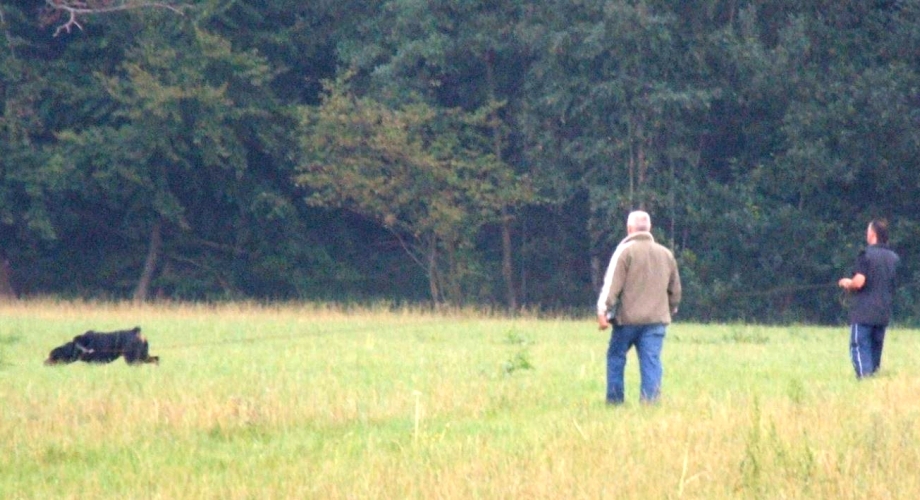
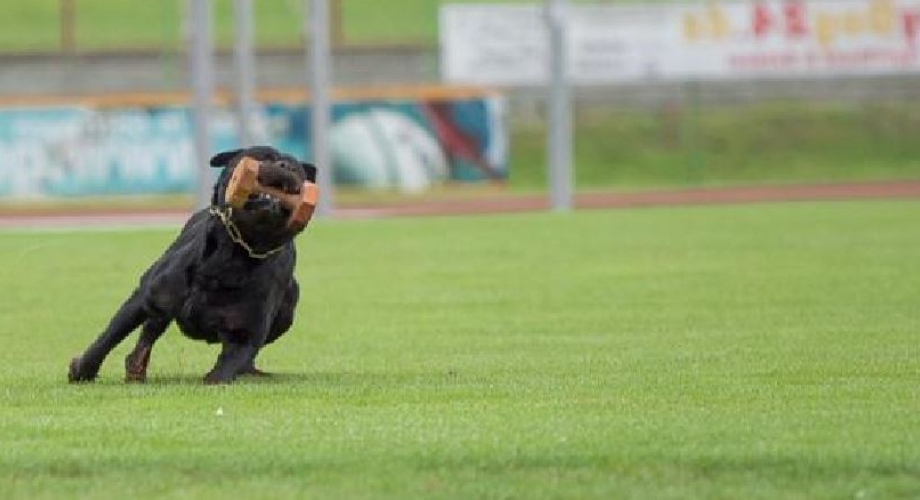
a object that belongs to his owner without presence of owner : 5 points (see
pic below)

•
jump
over obstacles : 10 points
•
jump
over a hole or canal : 10 points
•
defense
of the owner : 15 points
•
he attacks Helpers who are pointed by his owner : 10 points
•
he
saves a object out of a pool pointed by his owner : 15 points
Total
of 90 points.
This
first National Championship Ringsport was held after WW1, on 3 October 1926.
There where 9 competitors: 5 Mechelaars, 2 Groenendales and 2 Bouvier de Flandres.
Since than the program has changed several times but all of these exercises are
still, in one way or another, present in the modern trials. Meanwhile France has
his own Ring-program (French-Ring) and Holland: KNPV.
In
the beginning of the 90's one of the most known Mechelaar-breeders in Belgium
Mr. Luc Vansteenbrughe kennel "des Deux Pottois" was one of
the inventors and promoters of the international ring-program
"Mondioring". Mondioring is a mix of Belgium-, French Ring, KNPV and
SCHH. It also has 3 levels and has every year a world-championship held in a
different country. The first world championship "Mondioring" was held
in Belgium in the year 1994. The 4th W.Ch. Mondioring was also held in Brugge, Belgium on 3&4 October '98. A total of 35 dogs where
Mechelaars, 2
German Shepherds and one Tervueren. There were competitors out of Belgium, Germany, Italy, Spain, Switzerland, Austria,
USA, so perhaps the Mondioring will have a future such as the IPO/SCHH-program.
|
Note
Belgian Ring:
Belgian
Ringsport
In
1926, under the name "Grand Prix of Belgium", the SRSH/KMSH (Societe
Royale Saint-Hubert) organized its own championship for the first
time . The first winner was the Mechelaar bitch SADI (LOSH 13537
alias SADI WORTHY - LOB 10794). Because the SRSH/KMSH doesn’t recognize
the affix of the KCB, the dog was registered under another name by
the SRSH/KMSH. The same story with SAMOX (LOSH 20606) which obtained the
second place. His name by the KCB was SAM du THIRIAU (LOB 10280)
belonging to O. Durand. SAMOX was a son of the famous SNAP.
From 1926 to 2000, always a Mechelaar won the "Grand Prix of
Belgium" with the following exceptions :
a) the Groenendael NEROLO (LOSH 22277) won in 1929 ex-aequo with the
Mechelaar BOBY de BRUYERE-FRAIPONT (LOSH 20859). NEROLO won also the
title in 1931 before BOLLUX (LOSH 32278 - alias LUX de GALLIFORT -
LOB 12534)
b) the Tervueren XAVIER (LOSH 141222) won in 1952.
The
best results for another breed than the Belgian Shepherd Dog, was
the second place of the German Shepherd SWITO (LOSH 61915) in
1935 and the Bouvier de Flandres VUW (LOSH 135650) obtained also a
second place in 1952. VUW was a black Bouvier also called "Bouvier
de Roulers".
Won
the title minimum 3 times :
METTEKO
(ALSH 21704) in 1967, 1968, 1970 and 1971.
CLIP (LOSH 412720) in 1981, 1982,1983, 1985 and 1986.
JUL (LOSH 537353) in 1990, 1991 and 1995.
NIVER des TIGROUS (LOSH 643560) in 1996, 1997 and 1998.
|
Note
Mondioring: Mondioring
The Mondioring
(International Ringsport) is a working dog sport with new rules from different
national rules taken from the working dog sports in France (French
Ringsport), Belgium (Belgian Ringsport), Holland (KNPV) and a little bit
of SCHH from Germany.
Mondioring is tested in 3 progressively harder levels, earning the degree
Mondioring I (MR1), Mondioring II (MR2),
Mondioring III (MR3), with level III being the hardest.
The Brevet is the entry-level test of obedience and protection work, to assess
character, courage, trainability, and suitability for work.
The first MR-trial took
place in 1987 in Belgium, Tournai.
Since the 1th January 1995, the Mondioring trial-rules are under the law by the
FCI.

Bodo v Schloss
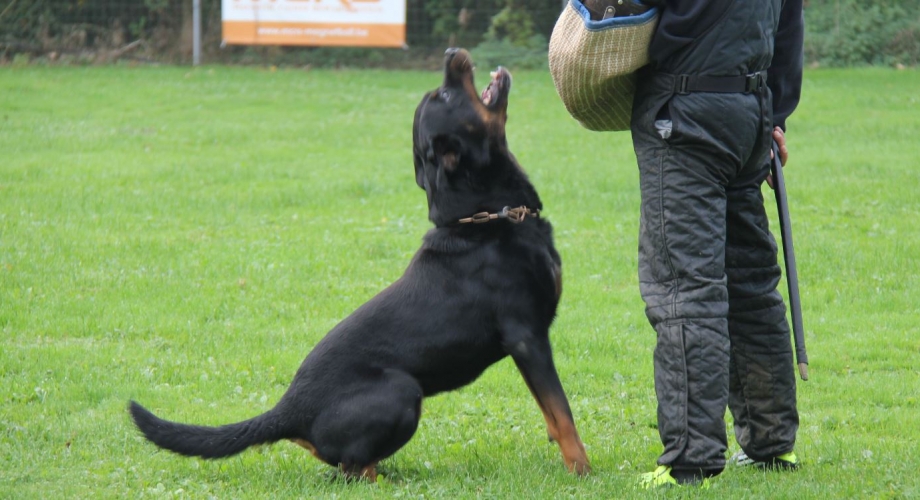
Hexental in conflict with Yurri Demeulemeester
Myself, I am a possessor of the "one and only
IPO-Schutzhund-program", but all my dogs have been trained on the Ring-biting-suit also, to be complete…We
do have several dogs from our breeding who are competing in Belgian Ring, French
Ring, Mondioring and KNPV.
Copyright
by Guy
Verschatse
Belgium
The
Rottweiler as Service-Dog
-Pro's
and Contra's for the Rottweiler as Service-Dog use.

Pro's,
the Rottweiler is:
the
most impressive working-dog (preventive intervention), the most self
assured and stable dog and by this calm (for long inside shifts ideal), the
most powerful biter (intervention), a excellent tracker (rescue,
narcotics).
Contra's,
the Rottweiler is:
a
"one man dog" (is not suitable for multiple handling), a slowly maturing dog (needs minimum 1.5 years to be useful), expensive as a puppy
(price is important for State and business), a very powerful dog (not
ideal for Explosives and Narcotics), a calm dog (not ideal for fast
outside interventions) and he bites too hard (higher medical costs for the
victims).
-Different
Service-Dogs. Police
K9
We
have different type of Service-Dogs. Service-Dogs are mostly used by
Police, Security, Army and Civil Protection (Firefighters, etc...).
The most common types of dogs are used for detection of Narcotics (Drugs),
Explosives, Rescue, Dead victims, also for Intervention- Preventive- and
Guarding purposes.
-What
treads are needed ?
First
of all "extreme preydrive", preydrive is the key to all
bite-, tracking- and retrieve work. We need this tread for Narcotics
(dogs trace drugs to find their toy), Explosives (dogs trace explosives to
get their toy as reward), Rescue on living people (dogs trace victims to
get their toy as reward) and Intervention (bitework is build up over
preydrive).
Second
is "self assurance", the dogs must be self assured
against all kind of situations such as traffic, all kind of slippery floors, stairways,
doors, elevators and gunshots (imagine a Policedog who runs away when
gunshots are fired).
Third
is "sharpness", the Service-Dog must have enough
sharpness to keep the guarding- and defense instincts. To conquer
eventually obstacles in his shift. Most of the situations demand a medium
sharpness, only serious intervention as for Army and Jail purposes demand
high sharpness.
Fourth
is "alertness", a too high self-assurance results in a
lower alertness. Low alertness is better for Rescue and Nose-work such as
drugs and explosives. High alertness is better for the intervention use, as
long the danger of "no focus" is not there. Some dogs/lines
seems to have the trait to see everything, except this what the handler
wants...
Fifth
is "hardness", all dogs must have enough hardness to
resist the stress of their work. Intervention dogs need extreme hardness
to go out there alone in hostile situations. Hardness is OK as long they
are "trainable", remember dogs who have extreme hardness need
very strong corrections.
Last
is "health", good health is a must for every working dog
! Some "showline breeders" seem to forget this...
-Why
is it important to maintain these treads ?
Because
these treads are the basics for all Utility breeds.
-Why
must we keep selecting on Service-Dog qualities ?
The
Rottweiler was saved by his Police-Dog ability back in 1910, his previous
task as herding dog made him useless as the herding of cattle ended in the
modern times. Most of the herding dogbreeds were saved by their utility as
guard and defense dog. It is very important that our breed is still used
by State-authorities for the positive image. And also as safety for not
being banned.
-What
is the recent selection ?
Recent
selection is mostly done by Clubs, Army and individual breeders. Most of
the clubs select too much on sociability and not enough on working drives.
Their interest in working ability is too low and mostly the show qualities
are important. This is not healthy for "the total Rottweiler"... A
good start to improve the genepool's working ability would be the
introduction of the old ZTP routine for the "Working class" on
conformation shows. This is done for a long time in the GSD/WUSV world,
the morning of the actual show each dog entered in the "Gebrauchshund
klasse" has to do a KKL (read old ZTP) routine. The dogs who fail cannot
enter the show anymore. We must understand that no extreme test are
done, just the minimum to pass a test of this kind.
The
Austrian Army has a complete genepool of Service-Dog-Rottweilers, they
breed conform their own needs and rules and still have the true working
Rottweiler. They give no credit in health and working drives at all.
However the Austrian Army is a unique case, most other Army and Police
forces buy ransom useful adult dogs. Austrian
Army Kennels
The
most important selection is done by the breeder himself, they have the
most power to create and maintain a certain type or bloodline. Whatever
some clubs are thinking, the breeders are responsible for the reputation
and quality of a breed ! They make a country stand or fall... A respectful
breeder will select on the right treads, will stay critical for his own
dogs and will create a own (unique) genepool.
-How
far is this Sport- and Breedtest-selection changed from the original Service-Dog needs ?

Benno v Schloss
Hexental in conflict with Jacques Dupas
Very
far ! Most Breedtests are not testing one of the most important needs
for service use: the preydrive. The tests are designed to make our
Rottweiler suitable for the crowd, to make him a fashion dog. They want to
reshape the original dominance and natural defense-drive (not aggression)
into over-sociable, brainless fashion dogs. The once so precious diamond
is loosing all his sharp peaks.
From
the beginning of the defense-dogsports around 1918 till about 1990 the
trial routines were very useful as Service-Dog selection. Germany used the
so called Schutzhund competition as base of the breeding-selection for
dogs as the GSD, Dobermann and Rottweiler. However recently these sports (Schutzhund
and IPO) try to combine treats who are extremely difficult to combine. The
reason of this is the pressure of the society who wanted to ban all defense-dogsports. The concerning comities changed their rules very slowly
into more "acceptable for the society" which means less
dominance and more punctuality. The recent top winning sport dog is a
medium hard, low dominance, very tractable "robot".
-Selection
of Service-Dogs.
Companies
who test, buy & sell potential Service-Dogs have the same uniform
requirements:
|
|
|
General Behaviour
 | Should
be generally alert, free in temperament.
|
 | Able
to be taken by the leash by stranger and walked around.
|
 | Should
have no reaction to the gun of large calibre.
|
 | Should
have no problems with slippery floors, stairs , sliding
doors etc.
|
Physical
Condition
 | Dogs
should be in good weight. Skin should not have any
irritation, hotspots or broken hair. Vaccinations should
be up to date.
|
 | No
broken teeth or gum infection. Missing teeth and incorrect
bite are acceptable.
|
 | Ears
should be clean and free of infection and parasites. The
tip of the tail should be covered with hair and not soar.
|
 | The
dog should be moving freely, no lameness before and after
conclusion of the test.
|
Prey
Drive
 | Dog
should be tested in - and outside of buildings.
|
 | He
should retrieve rubber ball, plastic pipe and metal pipe.
If the toy is thrown and gets out of sight, the dog should
try very hard to retract it. If the toy is put under or in
a container he should try physically to get to it.
|
Temperament
Evaluation
 | Will
be tested in and outside of buildings that the dog is not
familiar with.
|
 | Handler
holds the dog on six foot (+/-2 m) leash, a stranger will
approach the team. The stranger will move slowly but will
not agitate in any way nor will he show any reaction to
the dog's action. Once the stranger is close enough, he
will be moving in a threatening manner toward the dog. The
dog should stay confident and show that he would bite the
stranger if he could reach him. The stranger will not wear
any equipment that could be associated with agitation, nor
is he carrying a stick or whip.
|
 | The
procedure is repeated with a sleeve held behind the
stranger's back. In the end phase the sleeve will be
presented and the dog should actually engage. The bite
should be firm and hard, fullness of the grip is not
important. During the bite the dog will be threatened with
an object (not hit). This could be water jug, stick,
plastic bag etc. If the dog stays on, the stranger gives
the sleeve to him.
|
 | After
the handler separates the dog from the sleeve, the
stranger takes the sleeve and walks away. At a distance of
50 yards (+/-40 m), the dog will be sent. The stranger
will turn against the dog in a threatening manner walking
toward the dog. The bite sleeve is carried in normal arm
position, to the side. If the dog shows that he would
commit to a bite the sleeve will be presented. The dog is
to stay on the bite until the handler approaches. The dog
should not show avoidance toward the handler or the
stranger at any time.
|
|
|
Note from a
Swedish friend: A very good test to see if dogs
have the right nerve construction is following
evaluation invented by Norwegian Army/Police. When
they travel around to buy adult dogs for their duty
services, they cannot do very complicated and long
tests. The essential needs for their purposes have
to be tested in a short and easy way, without using
many tools or help.
They take the dog and his owner to a small road in
the woods. The owner has to take his dog there on
leash and waits without saying anything to the dog.
20-30m further in the woods is sitting a person
hided under a blanket, important is that the dog may
not be able to see him from the road. Then when
everything is 100% quiet, the decoy starts to break
wood pieces over & over again. When the dog starts
to react on this the handler let's his dog go into
the dark wood and see if he has the guts to go up in
front of this decoy (who's not saying anything,
just keep on breaking wood). The owner has to stay
on the road and cannot encourage or help his dog in
any way. The dog must be able to go inside of the
wood and try to handle this test without support
from anybody.
This seems so simple, but extremely many dogs cannot
handle it ! They can't handle this "simple" test
alone...
-The
Belgian Ringsport-selection.
The
Belgian Malinois was made true selection of Ringsport. After one century
of Ringsport competition he turned out in the dog he is today, this
without any Breedtest nor Breed Suitability Test. The Ringsport selected
which animals would be bred and which not. Only the winning males were
used for breeding. Hip- nor Elbow X-rays were
taken because the Belgians felt that if a dog could jump daily 2 m high
and 4 m far for several years, he must have sound HD and ED. This way of
thinking was not so bad as when we compare the healthy and useful Malinois
with other working breeds such as GSD and Rottweiler. The German system of
selecting is by SCHH, breed survey's and Koerung's. When we see how we
lost the working capacity of our breed it should make us think. Nowadays
Dogtrainers are desperate to find the suitable competition dog, Police
Officers massively choose for the Malinois instead of the Rottweiler and
GSD. Maybe we've forgotten the real essence of what is important and
what's not...
Copyright
by Guy
Verschatse
Belgium
Thoughts on today’s Working
Rottweiler
Following
questions can only be answered from those who are knowing the genepool
in many different countries worldwide. A few of us have the luck to see
other parts of the world, not as a tourist but as a Rottweiler
enthusiast. What is the general opinion about the state of today’s
Working Rottweiler ? Where is the best potential as far as Working
Rottweilers ? Where are the next generations of working champions going
to come from ?
We can answer these questions from 3 different views: the view of the
Breeder, the view of the Buyer (read: Trainer) and the view of the
“Advocate of the Devil”…
-The view from the
Breeder.
For where I
personally have been and seen (some parts of Belgium, Holland, Germany,
Austria, Switzerland, France, Portugal, Bulgaria, UK, Norway, Canada,
USA, China, Malaysia) is it 5 past 12...
The most impressive dogs I've seen were in Belgium, Germany, Austria,
Switzerland and Norway.
Especially USA and the “land of the rising sun” (Asia) are paying too
much attention on show and exterior to have serious success on the
working field. That’s why almost all of their good competing dogs are
imports.
The other countries I've spoken from seem to mix everything, which
results in a mix of all kind of bloodlines and types. The training
quality and motivation of the trainers are also from very high
importance, no good trainers, no good dogs.
In my opinion Switzerland has the most working lines overall, they use
only exclusively German working lines, however none of the Swiss
genepool seems to stick his head up on international trials... I have no
answer for that, maybe it’s a lacking of interest for commercial
business, who knows.
Austria had the best working bloodlines till about 15 years ago, from
than on they became more commercial and commercial means: correct
"show". Before that the politics of the Austrian Club/Breeders were
anti-commercial. I remember writing letters (before the internet area)
to all Austrian breeders asking for buying a puppy or information on
their pedigrees, no response came back. It was after repeating the same
letters, some answers came.
I think Germany has on this moment still the best working dogs, remember
over there they are still trained "the old and hard way". pincollars,
corrections for everything, force, etc.
I blame the "Positive Reinforcement Method" for creating a genepool of
softer dogs, maybe with more play (prey) drives. At least something
positive... A dog trained the "traditional way” needs more power to
stand the stress and corrections, than a dog trained the positive way.
What you see is what you get !
Breeding has nothing to do with the talent or the way of training of the
owner.
Seeing these dogs in other countries didn't change my opinion on the
Working Rottweiler, it only changed my hope fore finding a better
genepool in a strange country. I had high hopes to find better or
ultimate dogs/bloodlines in one of my journeys, but i came to the
conclusion that it is right before my eyes: Western Europe !
Maybe the health and endurance of the Scandinavian bloodlines mixed with
some harder, taxable, tough blood from over here would give the best
results...
I'm seriously thinking about it ! I had a nice opportunity from a
interesting female owned by the President of the Norwegian Rottweiler
Club and our stud “Bodo v Schloss
Hexental”, but I was too blind to see.
She had one of her best litters ever, she told me afterwards.
Maybe next time, there are a few breedings coming up from hopefully
interesting females. (this is also a wink to you breeders with the right
females). I think that the future of the working Rottweiler is in
Scandinavia, especially in Norway and Finland.
future will tell... hopefully I'm wrong.
The
Scandinavians have a very healthy population, they were the first to
examine HD/ED, they have statistics of most of their genepool, many
generations back. The reason why they have such a healthy genepool is
maybe an insurance thing, they have some sorth of “health insurance for
dogs”. This forces them to buy from “perfect healthy” parents. This and
the type of endurance sports they practice over there, makes their
Rottweiler different from type as the Western European Rottweiler.
-The view from the Trainer.
When a
“coutry” like Scandinavia gets more time, most other countries will have
a hard time to beat them, because dogsport has changed and they practice
exclusively towards this new type of judging. It’s about time that
people start to see that there’s a lot going on in the recent dogsport-world:
certain ways of new training seems to become more popular as other. The
Judges nowadays like to see a controlled, happy and friendly dog. There
are many potential Working Rottweilers al over the world, there is just
something wrong in the training. Sometimes you can get much more out of
your dog than you ever know, it’s just the right type of training who
will make the Rottweiler perform at top level. Breeding is giving and
taking, so is training. We need Rottweilers with the drives to compete
over and over, a Working Rottweiler has to sport and get results, that’s
number one. The “Positive Reinforcement System” (clicker) is the key to
top performing Rottweilers. The right training is more important as the
bloodlines.
-The view from the Advocate
of the Devil.
Why became the Working Rottweiler a “rare” breed ?
"Working"
is not only dogsport ! Dogsport is just a part of working. Dogsport was
ment as a artificial test to maintain the working qualities in working
dogbreeds. I personally find that SCHH is not the "only thing”. Remember
the Ringsport is the selection of the Malinois. Doing both would be
ideal, or a mix of both.

Uran du
Detroit Lancaster, the best Belgian Ringsport Rottweiler ever in
conflict with multiple Belgian and Worldchampion Mr. Bruno Misselyn
If breeders of working dogs would only select their breedpool from the
"positive trained and top scoring SCHH dogs" (clicker dogs), the working
dogs are as good as dead !!!
The score is not so important as being impressed by the power of the
dog. A good dog must display power: a quality that should never be
overlooked or dismissed when making breeding selections. A good sportdog
may not necessarily be a good producer and vice versa ! There are
several examples in the past. As long as the owners are honest about the
“real” qualities of their dogs when using or promoting them for
breeding, there is no real problem…
Sport/reality vs breeding of Working Rottweilers.
Where is the power and resistance/countering gone in the recent SCHH
sport-bitework ? Silent guarding with give me, give me look on the dog’s
face and a tail wagging around telling everybody that this is pure
preydrive. The dog is staring at the sleeve, the Helper could walk away
leaving his sleeve on the ground. The dog would still "guard" the
sleeve. These are the signs of a Sportdog, but not of a workingdog !
The problem
starts here: nowadays the judging of sportdogs is totally different
compared to 15 years ago. In the old days the figurant had a bamboo
stick, now it’s a padded softstick, pincollars were all over the place,
now pincollars are forbidden. When a dog showed some kind of reservation
(read: aggression towards strangers), nobody cared. When a dog had a
heavy “out”, nobody cared. The sport gets further and further away from
the real business, the new training techniques prefer a following,
social preymonster.
I´m
especially against silent guarding and all of these positive stuff
(clicker). I mean if we “help” the dog to pass the tests with these
“tricks”, we are going in the wrong direction. A dog should be able to
pass a test without tricks.
Training the “old school” with pressure, aggression and corrections, the
control and definition may be not so good in trials, but the dog is
really strong and he´s not there for playing. He’s there for real,
that's what we should prove the audience and Judges. Our dog his
qualities, we are just there to give the commands.
Real life workingdogs, the Militar or Police want a dog to have enough
aggression because it is a necessary tool to have in training and of
course in the real world when needed.

Impressive
image of an Austrian Army Dog out of the famous Kaisersteinbruch
Kennels.
If the SCHH people and specially the breeders don’t need (or don’t want
to use) aggression anymore, where are we going to find the working dogs
in the future ? Military, Border Patrol and Police have their own tests
and training, but they don´t do any breeding what so ever (except for
the Kaisersteinbruch-kennels in Austria). They just need about a few
hundred new dogs every year. All of these working dogs are bought from
civil breeders, the same breeders that we bought our sportdogs from.
Same lines, same qualities and same parents.
If we don’t stress and train them in maximum limits and just go for the
preymonsters/easy to handle kind of dogs, what then ? 5-10 years and all
of the aggression capability in our dogs is gone ! Would you want to
work with this so called social and loving dog as servicedog in the real
world ? Not me.
Loose some
points over the power and drive should be OK. But that doesn´t mean that
we should not try to maintain perfect technical level. Often
aggression-drive gives problems in the control phases and some other
things. But that is not the dog´s fault or mistake. It´s the trainer’s
mistake. It’s up to the handler to get the maximum out of the dog. If he
cant handle it, than he’s not the right handler. This is an important
issue for the breeders, to know who made the mistakes.
A sportdog
and a workingdog should be one and the same ! This is the bottom line of
all working breeds.
The
Positive Reinforcement Method and the “danger” of it.
There is a big difference in “reactive” and “active” dogs. Clicker dogs
are waiting for the click: Reactive. They bite after the click. Where is
the dominance and aggression ? When they bite, they just do their job,
no countering, no thinking, no nothing!
Click, preybite and fun !
The clicker
makes reactive dogs (especially with food !).
On the
other hand they say that the click is not helping the dog and the use in
the bitework is only to have better control, the click is the
announcement to the actual reward. This means when your dog does
something that you want (by himself or by command) he gets his reward.
By this he will repeat this behavior. So you click and “send” him to
bite, not doing what you want means: no reward, and that exactly is the
“punnishment” for the dog , especially when you have a dog who is
longing to bite. For the rest you can work the dog or raise him in
bitework the way you want . Thing is that the dog gets no corrections
anymore. No correction, no stress, no stress, no taxability test, no
taxability test, watering down of the drives… It is a given fact that
when dogs are not tested in their original task, the drives (or is it
the breed) watering down. After a few generations it’s just a look-alike
anymore, a fake copy…
The
positive reinforcement method means technically:
Classical
examples, aka Pavlovs test: "Bark">Click>Bite.
Aggression >BARK (with dominance)>Move>Bite and counter with dominance,
can also be done "Bark">move the sleeve>bite...preybite.
With the clicker (or the positive system) you can make the dogs more
correct and you can also make weaker dogs better looking. What you see
is not what you get.
As for the bitework, the clicker is not making the dogs more friendly or
softer. It just makes the dog more reactive. The rebel type of dog is
not preferred. Dominance and aggression is not tested or used.
My experience is for "the traditional training type" of bringing the dog
in high defense and aggression during the bitework (whip), that the dog
cannot canalize the requested as good as in lower aggression. With other
words: a dog who is hysterical cannot learn and must be corrected very
strong to learn something. Which takes more time + pressure = stress.
There is
also a limit on these drives , all the drives who are too high will give
conflicts somewhere, and on the other hand a dog cannot have drives
enough. However the more drives, the more talent and experience the
trainer needs.
Helmut Raiser (the Godfather of SCHH video’s and books) does obedience
over preydrive (learning to use aggression in obedience because it gives
a great boost).
He doesn´t like to see food training, because the dog is doing it for
the treat and not for the handler ! Someone could say that that’s the
same with the ball or preydrive in generally. I´m saying no is not ! Why
? Because of the corrections and "force" in this reward.
When it´s done right, the ball is not the reason why they obey the
commands. Its a packdrive thing, a way to lower the stress but also
authority.
How do you see the difference? General outcome and tail ! When a dog
does serious obedience (not by positive stuff), the tail is not wagging
around ! Fun and obedience should be the same in the early stages. We
should strive that our dog does obedience everywhere and anytime,
without clickers, balls, pincollars or any other device or toy...
The tail and ears tell you everything. SCHH guarding, impressive and
serious bark, no tail wagging means real business. The tail wagging
around and having fun (read: preydrive "barking") barking for points is
nowhere near active aggression or dominance.
Point here is that, why should the technical performance be more
important than the dog's natural drives ? Are points more important than
the dog it self ? When you go to see a SCHH trial, do you go there to
see the dogs or the handlers and their skills of training ? We should
strive to see good dogs, not good handlers. Although they walk hand in
hand.
I prefer in any given day a great dog and poor handler and not the other
way around. Purely based on breeding issues. IPO and SCHH are
meaningless sports if they are done wrong (read: I want to win any
possible way I can. My dog suck’s, I don´t tell it to anyone. I´m such a
good trainer that I can hide all his faults)...
Should the best dog win the trial, or the best handler ? This is also a
VERY important question for the breeders ! You don’t breed the handler…
The thing is that the relationship between the handler and the dog must
be correct and optimal. You can get good heeling and good obedience
without having a good relationship, we see it a lot within these
positive trained dogs. But then the handler is counting on the dog to be
tricked into thinking that at any moment the reward (ball or food) is
coming. It is better to know that your dog is going to give you good
obedience for the simple reason because you gave the command. That is
true obedience that will never let you down, but maybe will result in a
lower score.
There is a difference between being the person that controls the
rewards, and being the true handler.
Relationship is more important than balldrive, fooddrive, or any other
motivator. In this I mean that the handler is the dominant half of the
team, that the dog is totally submissive to the handler's wishes in
every way shape and form. The ball, toy or food are just devices to
release the stress of this type of relationship. The reward is just a
manner in which the team finds success through pack team work. The
handler being the leader in the pack.
If a dog is more attracted to the handler than the ball (or any thing
else) then the relationship is correct. An example is if you throw the
ball away, the dog should bring the ball back to the handler and not run
around with it. When you see this in a relationship, you know that team
has a good relationship (bond). You don't have to have this type of
relationship to do good obedience, but it sure makes you feel extremely
confident when you enter the field with this type of relationship. You
don't have to worry about distractions or other people clicking...
Resume:
The “Traditional way (Raiser) of training” shows the real inside of the
dog, test and taxes him in most important drives.
The “Positive way (clicker) of training” shows more of the qualities of
the handler and don’t use all his drives. It’s definedly the most
dog-friendly training, however it does not guaranty the necessary drives
to maintain a working breed.
Competitions like Ringsport, Mondioring and KNPV are till this moment
free from “positive way training”, maybe we should introduce more studs
or females who practice these “reality sports” in our breeding programs.

Baldur v Schloss Hexental demonstrating the typical inside-arm bite of
the Dutch KNPV Program.

Bodo v Schloss Hexental at his Mondioring 1 exam.
Copyright
by Guy
Verschatse
Belgium
|